Certificate Holder vs. Additional Insured: The Difference That Matters
A certificate holder receives evidence of insurance; additional-insured status depends on the policy or endorsement. Here is how to verify the difference without relying on a checkbox alone.
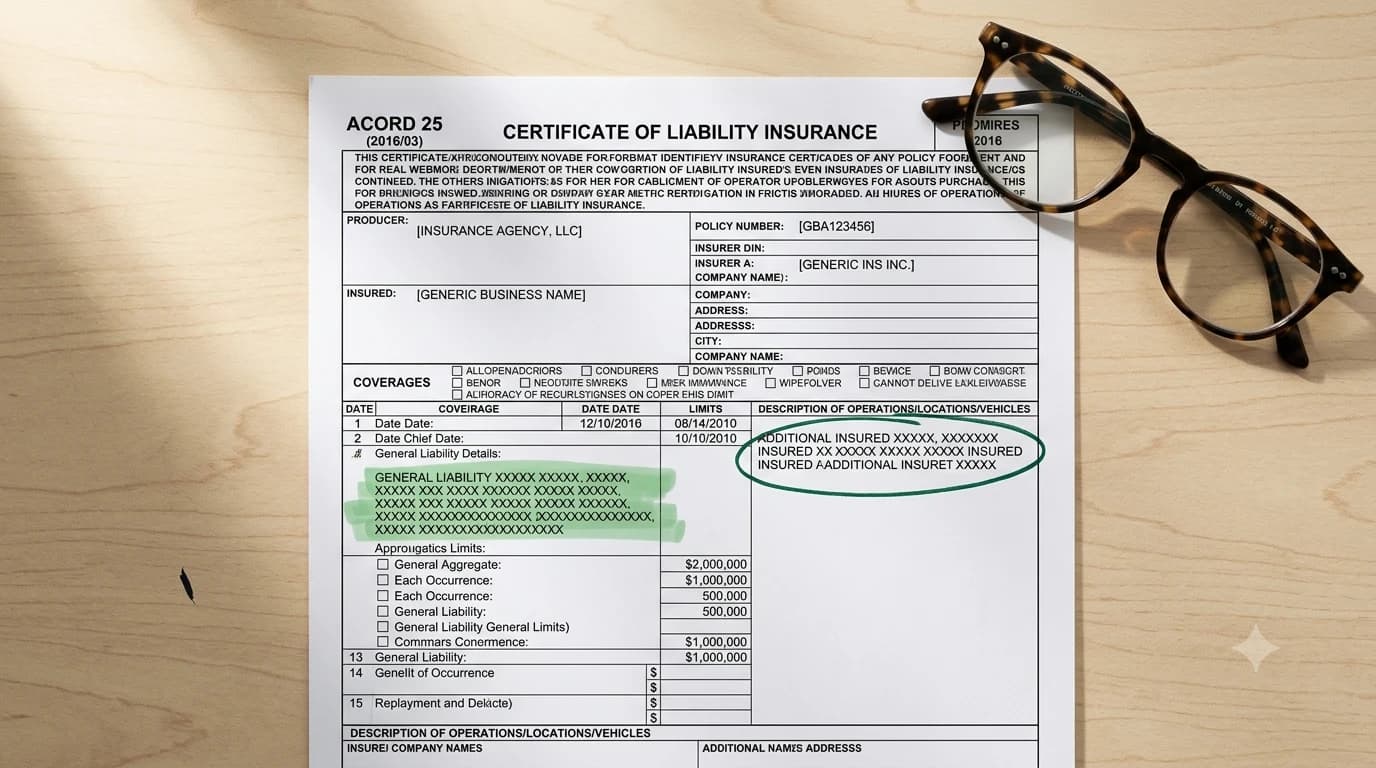
A certificate holder is the recipient of insurance evidence. An additional insured is a person or organization granted insured status under the policy or an endorsement for a defined scope. The two terms are not synonymous, and a certificate cannot create additional-insured coverage that the policy does not provide.
What a certificate holder actually gets
A certificate holder is typically the party receiving evidence that another business has certain insurance in force. That may be a venue, landlord, client, property manager, or general contractor. Receiving the certificate does not, by itself, make that party an insured under the policy.
New York’s Department of Financial Services has expressly stated that certificate holder and additional insured are not synonymous. Its guidance describes a certificate as evidence of insurance and explains that the certificate cannot alter the underlying policy.
What additional-insured status means
Additional-insured status is created by the policy wording or an endorsement. The scope can be narrow: it may apply only to liability arising out of specified operations, locations, contracts, or relationships. It may also be subject to exclusions, limits, conditions, and other policy provisions.
That is why the phrase “add them to the COI” can be misleading. The operational request is usually to add or confirm the party as an additional insured under the policy and then issue a certificate reflecting that fact.
Why the checkbox is not enough
Texas Department of Insurance guidance says an additional-insured box should be checked only if the policy includes an endorsement that names or otherwise covers the certificate holder as an additional insured. The certificate cannot promise coverage that the underlying policy does not contain.
For a small business, the safest workflow is to send the exact contract language and legal name of the requesting party to the insurer or broker. Ask what endorsement will satisfy the request and keep the endorsement or confirmation with the contract file.
Common mistakes that create rework
Many COI problems are administrative rather than coverage disputes. They still delay jobs and payments. A certificate can be rejected because the legal name is wrong, the limits do not match the contract, the policy expires before the event, or the required endorsement is missing.
- Listing a DBA when the contract requires the legal entity name
- Assuming certificate holder status creates coverage
- Checking additional insured without an endorsement
- Using an expired or soon-to-expire certificate
- Ignoring primary-and-noncontributory or waiver wording in the contract
- Typing special promises into a certificate that are not in the policy
How to respond to a client request
Ask the client for the written insurance requirements rather than a verbal summary. Forward that language to the insurer or broker, including the exact project, date, address, and legal entity that wants evidence. If the request cannot be met, learn that before signing or mobilizing.
Do not manually edit a certificate to make it look compliant. Regulators in multiple states have warned that certificates should not alter or expand policy terms. If an endorsement is needed, the insurer must handle the coverage change.
What to save in your job file
Keep the signed contract, certificate, applicable endorsement, and relevant email confirmation together. If the client later asks for revised wording, the file shows exactly what was requested and what the insurer issued.
For recurring clients, do not assume last year’s certificate remains sufficient. Contracts, policy forms, limits, and endorsement wording can change at renewal.
Primary and regulator sources used
We use government, regulator, and other primary sources for insurance mechanics, state-authority routing, worker-classification, property, claims, and cyber-security guidance. Policy language and state rules still control your specific situation.
Frequently asked questions
Can someone be both certificate holder and additional insured?
Yes. A party can receive the certificate and also have additional-insured status if the policy or endorsement grants it.
Does being listed in the description box make someone additional insured?
Not by itself. The actual policy or endorsement determines insured status.
Can I edit the COI myself?
You should request certificates and corrections through the insurer, agent, or broker. Do not create policy promises by manually changing evidence of insurance.
Free tools
Turn this article into an action list
Use our downloadable checklists, worksheets, and fillable PDF forms to review a contract, compare quotes, track COIs, prepare for renewal, or document a loss.
Browse free templates