Commercial Property Coinsurance Penalty: How Underinsurance Can Reduce a Partial-Loss Payment
A practical small-business guide to coinsurance percentages, insured-to-value checks, partial-loss penalties, and renewal documentation before a property claim exposes a limit problem.
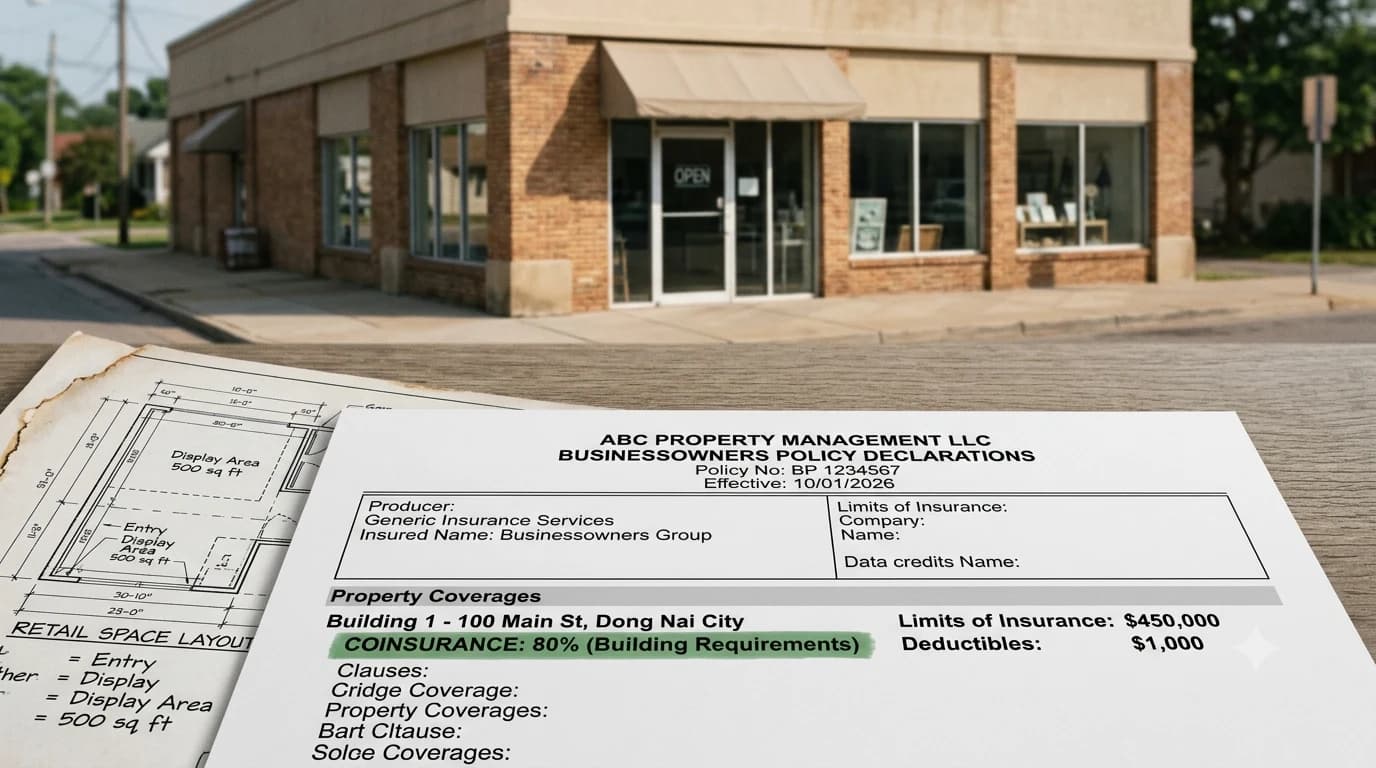
A commercial-property coinsurance clause can reduce a covered partial-loss payment when the insured value is lower than the percentage of property value required by the policy. The limit, property value, coinsurance percentage, deductible, valuation method, and any agreed-value or other endorsement all matter. Do not estimate the answer from purchase price alone. Record the current replacement-cost basis used for the building or business personal property, identify the coinsurance percentage shown in the policy, and ask the broker or insurer to explain how the policy would calculate a partial loss under the current values.
Why this clause matters even when the policy limit looks large
Coinsurance is easy to ignore because it often appears as a percentage on the declarations while the owner focuses on the much larger dollar limit. The practical problem shows up after a partial loss. A business can have a $500,000 property limit and still discover that the policy expected a higher insured value relative to the building or business personal property value. California's commercial insurance guide specifically warns that underinsuring a building can create a monetary penalty at the time of loss. That makes coinsurance an insured-to-value problem, not a health-insurance cost-sharing concept.
For a small business, the right question is not simply whether the limit is enough for a total loss. It is whether the policy's valuation basis and coinsurance percentage are aligned with current replacement costs. Construction prices, equipment upgrades, tenant improvements, inflation, and newly purchased inventory can all make an old limit stale. A worksheet is useful because it forces the owner to separate building value, business personal property, stock, tenant improvements, and any property of others instead of rolling everything into one remembered number.
The calculation is policy-specific, so test the inputs before using a formula
A common coinsurance calculation compares the amount of insurance carried with the amount that should have been carried under the policy's percentage requirement, then applies that ratio to the covered loss before the deductible. That general idea is useful for understanding the risk, but the actual claim calculation must follow the policy and endorsements. The valuation method matters because replacement cost and actual cash value do not produce the same property value. Separate limits or blanket limits can also change what amount is tested.
This is why a spreadsheet should be labeled as a review worksheet rather than a claim-settlement calculator. Use it to surface missing inputs for the broker or insurer: current property value, applicable percentage, limit shown on the declarations, deductible, and any agreed-value, inflation-guard, margin, blanket, or valuation endorsement. If any of those terms are unclear, the worksheet should show 'verify' rather than manufacture a precise payout.
A partial-loss example shows the hidden exposure
Assume a small fabrication shop carries a building limit that was selected several renewals ago. The shop later adds electrical work, interior improvements, and specialized fixed equipment. A fire damages only one part of the building. The owner may think a partial loss cannot threaten a limit that is still much higher than the repair estimate. But if the current value has risen enough that the policy's insured-to-value requirement is not met, a coinsurance provision can affect the amount recoverable for that partial loss, subject to the actual policy.
The lesson is operational: update values before the claim. Replacement estimates from a contractor, building-cost tool, appraisal, equipment schedule, or insurer valuation service are more defensible than last year's premium invoice. Keep the dated basis for the number. If the insurer later changes the recommended value or the policy moves to a different valuation approach, the renewal file should show why the limit changed.
Build an insured-to-value file, not just a declarations-page screenshot
The supporting file should include the current declarations, property statement of values if one exists, recent appraisals or replacement estimates, major capital-improvement invoices, equipment purchases, tenant-improvement records, and photographs. For business personal property, keep an inventory that distinguishes owned property, leased property, stock, and property of others. If seasonal inventory swings materially, document the peak rather than only the quiet-month balance.
The downloadable coinsurance worksheet for this article includes fields for value basis, valuation date, percentage, limit carried, calculated target insurance, major additions since valuation, deductible, and endorsement status. It is intentionally a review tool. The owner can send the completed sheet to the broker with a direct question: 'Do these values and endorsements satisfy the policy's current insured-to-value requirement, and if not, what needs to change?'
Do not confuse replacement cost, market value, tax value, and purchase price
Commercial property insurance is not generally priced from what a buyer paid for the real estate. Land is not rebuilt after a fire, while construction labor, materials, debris removal, code changes, and specialized improvements can drive reconstruction cost above or below market value. Tax assessments have a different purpose again. For movable business property, book value can also diverge sharply from current replacement cost. A fully depreciated machine on the accounting records may still be expensive to replace.
The California and Texas commercial-property guides both emphasize the need to understand valuation and policy limits. The safe workflow is to ask what value basis the policy uses, obtain a current value on that basis, and then compare the insurance limit with the policy's coinsurance or agreed-value structure. An owner's private estimate is useful as a starting point but should not be presented as an insurer-approved value unless the insurer actually accepted it.
Situations that deserve a midterm review
Do not wait for annual renewal when the exposure changes materially. A new location, renovation, major equipment purchase, large inventory build, lease requirement, acquisition, or change from tenant to owner can all alter the property values that support the policy. A business that adds expensive leasehold improvements should also confirm who is contractually responsible for insuring them. The lease and the property policy should be reviewed together.
The same principle applies after a loss at another location or a major property sale. If the policy uses blanket limits across several locations, changes at one site can affect how the total program should be valued. Ask the broker to explain whether the limit is scheduled by location or blanket, how coinsurance applies, and whether an agreed-value option or other endorsement changes the calculation.
Common mistakes that make a coinsurance review unreliable
- Reusing the original purchase price as the insured value for years without checking reconstruction cost.
- Assuming a high-looking policy limit guarantees full payment on every partial loss.
- Mixing land value with the cost to rebuild insured structures.
- Forgetting tenant improvements, permanently installed equipment, or peak inventory.
- Using a replacement-cost estimate while the relevant property is valued on another basis.
- Treating an online coinsurance formula as the policy's final claim calculation.
- Failing to keep the valuation date and documents that support the number.
A practical renewal decision
Thirty to sixty days before renewal, update the property values, list material changes, and compare the current declarations with the new statement of values. Mark any coinsurance percentage or valuation term that is not understood. Ask the broker to document whether the proposed limits satisfy the insurer's insured-to-value expectations and whether any endorsement changes the ordinary coinsurance treatment. Save the response with the worksheet and final policy.
That process does not guarantee a claim outcome, but it prevents a common information failure: discovering after a loss that the business and insurer were working from different property values. The goal of the worksheet is to make the valuation conversation happen while the owner still has time to change the policy rather than after damaged property is already on the ground.
Primary and regulator sources used
We use government, regulator, and other primary sources for insurance mechanics, state-authority routing, worker-classification, property, claims, and cyber-security guidance. Policy language and state rules still control your specific situation.
Frequently asked questions
Does an 80% coinsurance clause mean the insurer pays only 80% of every claim?
No. The percentage is generally part of an insured-to-value requirement, not a flat percentage applied to every covered loss. The policy's actual formula, values, limits, deductible, and endorsements control.
Can I avoid coinsurance by buying replacement-cost coverage?
Not necessarily. Replacement-cost valuation and coinsurance address different parts of the property coverage. A replacement-cost policy can still contain a coinsurance requirement unless an endorsement changes it.
What should I ask my broker to confirm?
Ask for the value basis, current property value used for underwriting, applicable coinsurance percentage, whether the carried limit satisfies that requirement, and whether agreed-value or another endorsement changes the ordinary calculation.
Free tools
Turn this article into an action list
Use our downloadable checklists, worksheets, and fillable PDF forms to review a contract, compare quotes, track COIs, prepare for renewal, or document a loss.
Browse free templates